
What Is Muscle Guarding? Why Your Muscles Sometimes Tighten to Protect You

Have you ever noticed...
...that after hurting your back, your muscles suddenly feel like they've locked up?
Or maybe you've been stressed for a while, and your neck and shoulders are holding alot of tension.
Most people assume the muscles themselves are the problem.
Which is sometimes the case.
But sometimes your body is doing exactly what it's designed to do.
It's protecting you.
This is often referred to as muscle guarding.
Your body isn't trying to work against you
Think of muscle guarding as your body's security system.
If your brain believes an area is injured, irritated, or under threat, it may increase muscle tension around the affected area to limit movement and protect you.
Often It’s a good thing.
I mean, if you've just rolled your ankle or strained your back, you probably don't want to be moving around straight away.
The body responds by saying “Hey champ,let's take it easy for a bit."
It's not just about the muscles
One thing I found really interesting while reading about muscle guarding is that it isn't just about muscles becoming tight.
Research suggests it's more of a protective behaviour driven by our nervous system.
You might notice yourself:
Holding your breath before moving.
Bracing without realising.
Some muscles might be tensed, even when you’re at rest.
Avoiding certain movements altogether.
It's your body's way of trying to keep you safe.
Stress can play a role too
Research suggests that guarding isn't explained by pain alone. Anxiety and feeling threatened can also influence how protective the body becomes.
That doesn't mean the pain isn’t there
It simply means our brain takes a lot of things into account, then decides how much protection it thinks we need.
Most of us have experienced this in some form.
Think about the last really stressful day or week you had.
Did your shoulders creep up?
Did your neck start feeling sore?
Headaches?
Stress affects more than just our brains it may change how our bodies feel and move too.
So where does massage fit?
This is where I think massage can be really valuable.
I don't believe massage "turns off" muscle guarding or fixes it permanently.
We live in such a fast-paced world, where rushing is the norm.
But what massage can provide is an opportunity for the body to feel safe.
A quiet room.
No emails.
No rushing
Just time to slow down.
For many people, that's enough to help them relax and feel more comfortable moving afterwards.
Recovery is bigger than massage
This also ties back to something I talk about a lot; the Recovery Hierarchy. To explore the recovery hierarchy further click here
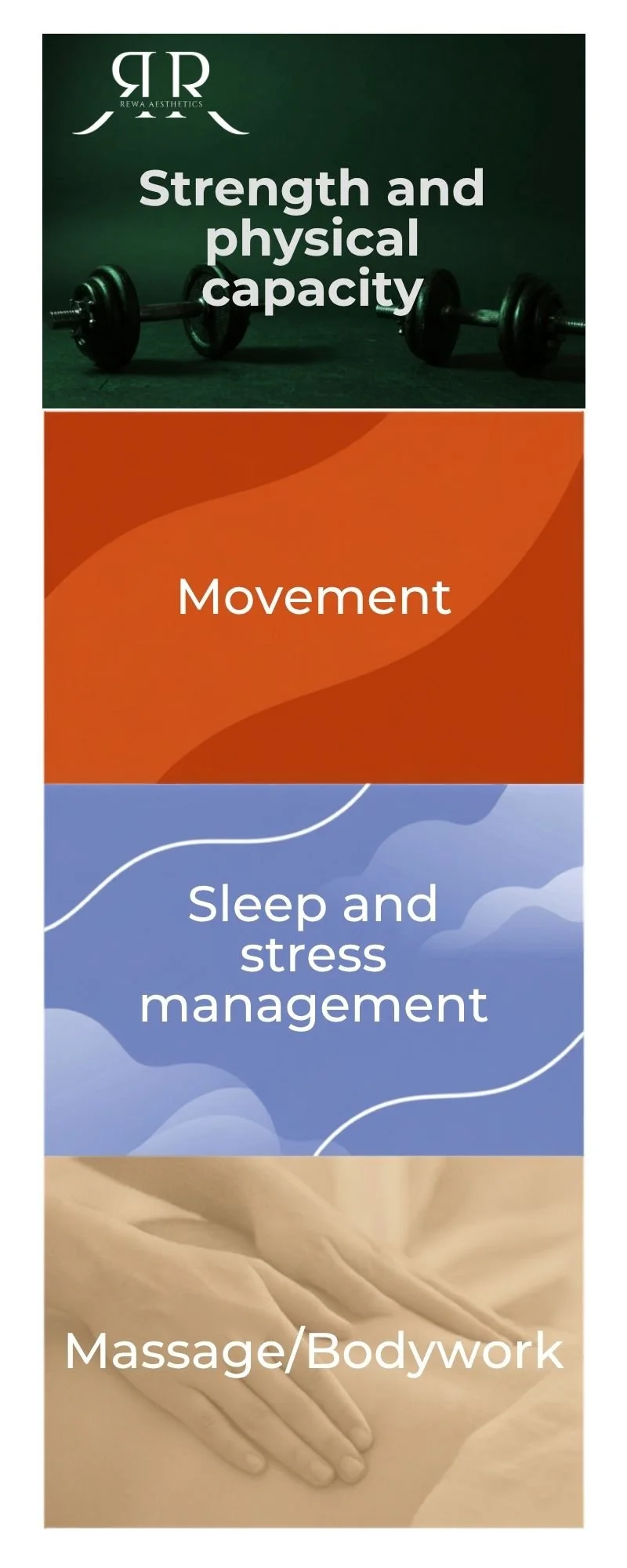
Massage is one piece of the puzzle.
Movement.
Sleep.
Managing stress.
Building confidence in your body again.
They all influence recovery.
Sometimes the goal isn't to force a muscle to relax.
It's to help your body realise it doesn't need to stay on high alert anymore.
The takeaway
Muscle guarding isn't out body working against you.
More often than not, it's your body trying to protect you.
Sometimes it’s helpful.
Sometimes it sticks around a little longer than we'd like.
Understanding why it happens can help shift the focus from trying to "fix" tight muscles to understanding what your body might actually be asking for.
Sometimes that's movement.
Sometimes it's rest.
Sometimes it's managing stress.
And sometimes, it's simply taking an hour out to slow down with a massage.
References:
Olugbade, T., et al. (2019). The relationship between guarding, pain, anxiety, and confidence in movement in people with chronic pain that restricted their activities. PAIN Reports, 4(e770).